Tuesday, 7 August 2012

My Period Is Late..! What does that mean?

No doubt, periods might be one of the most hated things that happen to you every month. Yet their absence or delay is even more bothersome since you need regular periods to enjoy a perfectly healthy gynecologic health. Are you watchful of your periods occurring regularly? Does your period date move back and forth from the expected date every month? Late menses is surely an indicator of some issue grounding roots in your body. Now let us try and get down to that root.

Below are some factors that can potentially cause late periods:
  • Stress: Increased stress affects your entire well-being and causes decrease in GnRH hormone levels that is responsible for ovulation. This delays periods.
  • Pregnancy: If delayed period is followed by unprotected sex, it is high time you undergo a self-pregnancy test.
  • Breastfeeding: While breastfeeding, your irregular menstrual cycles will take a small cycle of time to return to regular menses.
  • Anorexia or Weight Loss: Some eating disorders such as anorexia or unintentional weight loss can cause delay in your periods.
When to Consult a Doctor!
  • If you are missing your periods for more than 3 months in a row.
  • When your periods become irregular or erratic.
  • Your period lasts more than 7 days.
  • You have unusually heavy flow, wetting more than 12-15 pads or tampons in a day.
  • The time gap between two periods is either less than 21 days or is more than 35 days.
  • If you notice spotting on the days in between two periods.
  • Unbearable pain during periods.
  • Feeling feverish or sick during periods.
Are you a victim of late periods? What is the probable cause in your case? Consult a doctor for answers. After all, what is the point of harboring that fear in your heart? 


Friday, 3 August 2012

Pain during Sex – Are you suffering in silence!!

Painful sex might lead to no sex at all if it is prolonged and untreated. Saying bye to pain and not to love-making will open a healthier chapter for you and even for your love relationship. For most women, especially who shy away from vocalizing their feelings, sex is another name for pain and they view it as a painful experience always. To shake hands with enjoyment and to get the most out of your love-making experience, a little attention is what is needed to make this a pleasurably wonderful experience. The word Dyspareunia perfectly describes this condition in medical diction. Don't give any room to dyspareunia for disrupting your fun, destroying your sexual health, and dismantling your relationship. 

You need to know what actually is causing this and why you are not having so much fun during intercourse? There are very many common causes for this pain. Find out what holds true in your case. As the cause, so will be its treatment.    

Shedding Light on the Five Most Common Causes for Dyspareunia

  • Inadequate Lubrication: A good foreplay before actual intercourse is vital for appropriate lubrication effect and to lessen the pain during intercourse. Be open to discuss and if required suggest this to your spouse.
  • Vaginismus: This is most common in females who are 1st timers, overwhelmed and preoccupied with fears of performance during intercourse. Spasming vaginal muscles make intercourse difficult and painful. Don't let mental blocks block your mental, physical, emotional, and sexual health. A care-free and let go attitude will do the trick. It will relax your mind and body both together.
  • Urinary Tract Infection: You may be having an infection of your urinary tract. Don't worry, there is cure for this. Drink lots of fluids, stress on H2O intake. Your Gynae can help suggest an antibiotic for treatment.
  • Vaginal Infections: Sometimes yeast and fungal infections crop up in hot and humid weather and your badly sanitized pelvis plays host to these infections. The thumb rule to avoid this is to - STAY CLEAN.
  • Childbirth or surgery: After childbirth, many factors accumulate like stress, fatigue, exhaustion, decline in estrogen level which cause lack of sexual desire, which all can collectively cause pain during intercourse.

If you are having Dyspareunia, what is inhibiting you from enjoying this natural luxury. A little open discussion might open the door for your treatment.

Thursday, 2 August 2012

World Breastfeeding Week - Join the League

Just as the motherhood has come natural to you, so will be the urge to breast-feed your baby. Don't let it go! Stick on to it. Some babies might find it difficult to latch, but your patience and sweet persuasion will help your baby learn to latch quickly. When breastfeeding becomes a part of your routine, your baby will also get used to it and cherish it more than anything else. Your baby's taste buds will recognize your milk - give him/her the feast of breast-feed every few hours, but on demand!

Breastfeeding Is Easier Than You Think!

Feed it right, with a little insight - breastfeeding is easier and more convenient than you might assume. The best part about breastfeeding that it is the natural way of nourishing your child, and that too, without a cost. Feeding the baby with your milk is not just helpful in its growth, but it also boosts up your health too. Worried about your figure? Don't want to layer up your bones with an extra layer of fat? Breastfeeding helps to shape you up in long run. When you breast-feed your baby with your milk, it helps you maintain your physical health, improve your cosmetic appearance, and strengthens the emotional bond between you and your baby giving you immense pleasure and satisfaction.

Benefits for Mother
  • Breastfeeding minimizes the preparation time to zero in contrast to infant formulas that take too much time to prepare.
  • Breastfeeding not only helps you keep your baby healthy, but it also keeps you in shape, and works as a natural contraceptive. Chances of pregnancy while breastfeeding are very rare.
  • Breastfeeding will reduce the chances of you developing a breast cancer and even ovarian cancer later in your life.
  • You can also decrease the risk of becoming overweight and developing obesity with continuous breastfeeding.
Benefits for the Baby 
  • The initial breast milk is highly concentrated with Colostrum that is a perfect first food for your baby rich in bilirubin to prevent jaundice and can be easily digested.
  • Not only does the breast milk provide proper nourishment to your baby, but it also instills vital antibodies into your child's system developing greater immunity levels.
  • Breastfeeding helps to keep your baby healthy, active, fit and well nourished by providing necessary nutrients.
 So, how many times in a day your baby yarns for a feed and what is the average time gap between two successive feedings?

Saturday, 28 July 2012

Hepatitis can knock your health! It’s closer than you think

In 2008 the World Hepatitis Alliance launched the World Hepatitis Day to focus for patient and people living with hepatitis B and C. It is an opportunity to raise awareness about the disease, its facets and usher in some real change in preventing the disease and increasing access to testing and treatment. With huge support from governments worldwide, NGOs and international bodies like Médecins Sans Frontières, the World Health Assembly of May 2010 agreed to recognize World Hepatitis Day on 28 July.

Almost 1 in every 12 people lives with hepatitis B or C. If left untreated/unmanaged it will lead to severe liver scarring, maybe even liver failure or cancer. People worry more about HIV/AIDS but the fact is that every year some 1.5 million people worldwide die from either hepatitis B or C and that too way faster than they would from HIV/AIDS.


World Hepatitis Day provides a scope to focus on actions like spreading awareness to strengthen prevention, screening and control of viral hepatitis and its related diseases, increasing hepatitis B vaccine coverage, and coordinating a strong global response to increase awareness and ensure treatment of hepatitis.

The different type of Hepatitis viruses- A, B, C, D and E cause acute and chronic infection and inflammation of the liver leading to cirrhosis and liver cancer. Hepatitis is a major global health risk and affects some 350 million people who are infected with hepatitis B and some 170 million people infected with hepatitis C.
 
The 2012 theme is “This is hepatitis… It’s closer than you think” The disease does not discriminate- against age, race or gender, economic status, nothing so just confront it – get yourself tested. You can prevent Hepatitis A with safe food habits like avoiding cut fruits, street side juices, clean drinking water and such simple steps. A 2011 study showed over 42 million Indians suffer from chronic hepatitis B infection and vaccination profiles are shockingly lows. July 28 is just a commemoration – make every other day a day against the dreaded virus and only then will it be controlled.

Thursday, 26 July 2012

Are you at risk to trigger anemia?

Anemia is basically a decrease in number of red blood cells or presence of less than the normal quantity of hemoglobin in the blood. The condition includes reduced oxygen binding of hemoglobin in the blood. The condition is prevalent in India – some studies suggest that Indian women are prone to anemia and even the urban, educated women are susceptible to anemia. The condition may be severe, long lasting, and life threatening based upon hemoglobin levels in the blood with specific medical causes and traits, some of these include Iron-deficiency anemia, Folic acid deficiency anemia, Pernicious anemia (vitamin B12 deficiency), Aplastic anemia, Sickle cell anemia, Polycythemia vera and Trauma related anemia (mainly injured in a vehicle accidents). Nevertheless, it can be traced back to the food habit of Indian society. 

The statistics are shocking. A National Health Survey revealed that more than half the pregnant women in India are anemic. What is worse is that the percentage has increased from the 1990s. The National Family Health Survey dated 2005-06 (released recently) places India at 58.7% of anemic pregnant women as opposed to 49.7% in 1998-99. When the pattern in married women was studied, the trend was the same, but urban India women fared better than its rural counterpart at 50.9% as against 57.4% respectively. 

Scientists are doing their bit. Scientists at the Central Salt and Marine Chemicals Research Institute, Bhavnagar in Gujarat have developed double fortified salt, which they believe will be a boon for those suffering from iron deficiency or anemia. But the key to beat anemia is a good diet.

Some simple dietary steps would help prevent/cure most forms of anemia:
  • Consume adequate quantity of protein; include cheese, milk, eggs, fish or any substitute of meat products.
  • Eat foods rich in iron like green leafy vegetables, plantain, lotus stem, puffed rice, whole grain cereals.
  • Consume food rich in vitamin B complex, particularly B6 like whole grain cereals, parboiled rice, liver, milk etc.
  • Include citrus fruits such as amla, guava, green pepper, orange and lemon in your diet.
  • Include liver oil, fortified vegetable oil, sea foods for Vitamin E.
  • Ensure intake of foods rich in folic acid like pulses, green leafy vegetables, legumes and eggs.
As the typical Indian diet may not be ‘complete’ consult your doctor for supplements and fortified foods. If you have symptoms like feeling dizzy, fatigued, shortness of breath, weakness – it may be anemia. When was your last general health checkup or blood test done? Being aware about anemia is the first step to prevent it.

Monday, 23 July 2012

Reduce Weight the Natural Way

You have tried dieting, joined a slimming club, tried staying active and have surreptitiously mulled about the fashionable 'quick-fix' solution to lose weight. Did you know women are the main buyers of low-cal and low-fat food products and supplements? I’m not stating this to give you a complex. Stop and think for a moment. Are you taking the right route to weight loss?

For that you need to know your ideal weight. It is estimated that a BMI of 25-30 is normal anything lower or higher is unhealthy. The tables of ideal height to wealth ratio at fitness sites help but they are not sacrosanct. For some, muscle mass will weigh more than fat. Find out your correct Body Mass Index (BMI) before going for that fantastic ‘lose 10 kgs in 10 days’ Ads.

You need to eat if you want to lose weight. Truly. The lesser you eat the more your body stores fat. Eat smaller but frequent meals for higher metabolism. When we say we want to lose weight we actually mean we want to lose fat. That’s why these rapid weight loss fads often make the dieter ill rather than lean and fit. Crash diets can make your body low on energy and cause you high cravings for fatty, oily, spicy and sugary stuffs. And when you surrender at last and devour those foods, you are sure to eat more calories than you require, leading to weight gain.

What you need is foods high in nutrition and low in calories (not below 2400Kcal, the required calories for average women). Vitamin & mineral supplements may help but do consult your doctor before embarking on a regime. Milk, whole-grain cereals, fruits, veggies and nuts are rich sources of B-Complex, crucial to dieters. Chromium and Zinc are two important mineral that help your body process sugar and keep your weight in control. Fresh papaya drizzled with honey and lemon is a good source of such fat burning minerals. 

The golden mantra is, consume lesser calories than you burn and you will lose fat… err weight. And of course there is no real instant weight loss formula. Dietary changes need to be gradual & steady. Avoid refined and processed food in favor of rougher foods rich in fiber. Cut back on sugars and sweeteners like corn syrups that is equally bad. Taking your time for eating instead of gobbling will ensure that you eat the right portion.

Saturday, 14 July 2012

Are We For Population Freedom Or Population Control..!!


“Talking about population doesn’t mean control. It’s not about dictating how many children someone should have. It is about being knowledgeable about the decisions we’re making so we can make healthy decisions for a better future.” Says, Katie Elmore at Population Media Center

Every year on July 11, the United Nations World Population Day aims to raise awareness about population related issues since 1989.

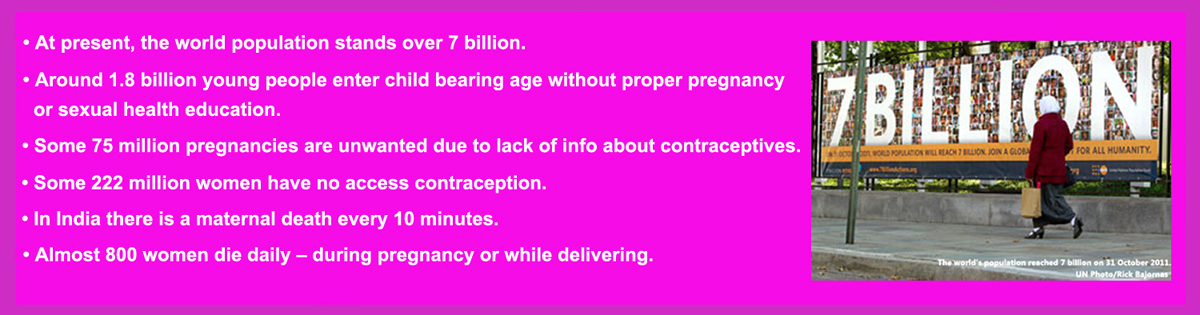
The theme for 2012 is “Universal Access to Reproductive Health Services”. The UNFPA vision aims for a world where every pregnancy is wanted, and every child’s potential is fulfilled. The ultimate aim of universal access to reproductive health by 2015 seems far away but we are progressing. Reproductive health related problems are the leading cause of illness and death for women of childbearing age worldwide.

Have a look at the UN estimates. They are staggering!


The figures are depressing. However it brings to fore how unsuccessful we have been in providing the very basic healthcare options globally. All the trumpets of development elucidated time and again with data and figures will ring hollow unless the basic is ensured for everyone. But even before that, people must know about their bodies, about the choices available to them and only a healthy mother today will ensure a healthy generation tomorrow.

Planned education including education on sexual and reproductive health would go a long way in empowering people to make the right choices about issues like marriage, family planning etc. A simple fact is that if women bear children before the age of say 20 or 21 then chances of a healthy offspring decreases dramatically. Knowledge itself does not heal, it empowers decision making.